Traffic Escape!
- 4.6
- Rating
- 10.00M
- Installs
- Free
- Price
 Analysis by App-foxy
Traffic Escape is the kind of puzzle game I reach for when I want something immediately understandable but still capable of making me think. Its central idea is simple: I tap vehicles to clear a jam, but the order of those taps matters because blocked cars cannot always move when I want them to. That small rule creates the entire challenge. It is easy to start, quick to understand, and surprisingly good at turning a spare minute into a longer session.
After spending time with it, my main impression is that Traffic Escape works best as a short-session logic game rather than a deep puzzle experience. It gives me a satisfying problem to solve without demanding a long tutorial or a complicated control scheme. At the same time, players looking for a story, a large strategic system, or endlessly fresh mechanics may eventually find its formula repetitive. I would recommend it to people who enjoy visual traffic puzzles and gradual problem-solving, while warning more demanding puzzle fans that its appeal depends heavily on how much they enjoy repeating the same basic interaction in increasingly awkward situations.
How the traffic puzzles feel in everyday play
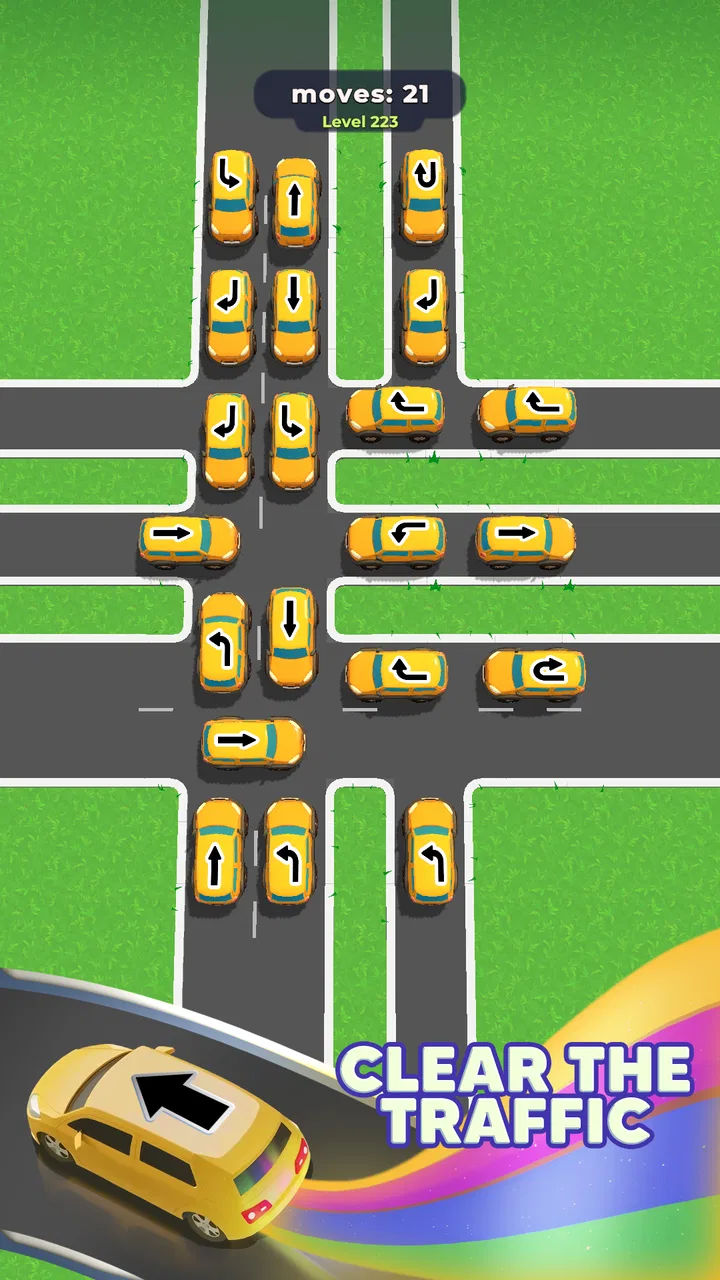
The game places a crowded road scene in front of me and asks me to find a safe route out. I tap a vehicle, watch it leave when the path is clear, and then reassess the remaining traffic. The important part is not speed. It is reading the board before making a move. A car that looks ready to go may be trapped by another vehicle, while a less obvious tap can open the space needed for several later moves.
You May Also Like

 Blood Strike: 2.5 Anniversary
Blood Strike’s Loadouts Turn Every Drop Into a Tactical Gamble
A close look at Blood Strike’s custom loadouts: how fast access to signature weapons reshapes its battle royale rhythm, rewards preparation, and narrows the gap between fights.

 Pandora - Music & Podcasts
Pandora’s Music Is Easy to Start, but Harder to Recover
Pandora’s strength is its low-effort path from a seed to a station. Its weak spot is how much confidence it asks you to place in connection, setup, and quiet recovery.

 8 Ball Pool
 Is Built on Rivalries, Rematches, and Routine
A close look at the rivalries, rematches, shared routines, and unanswered safety questions that turn a quick pool match into a persistent mobile community.

 Samsung Music
’s Quiet Strength Is Playing What You Already Own
Its reach comes less from spectacle than from dependable access to a personal library. That simplicity is both the app’s strongest retention engine and its ceiling.

 AccuWeather: Weather Radar
AccuWeather Review: A Quick, Clear Forecast for Everyday Decisions
For everyday plans, the best forecast is the one you can understand quickly. AccuWeather makes rain timing, radar, and local conditions easy to act on, with a few trade-offs.

 Hill Climb Racing
Why Hill Climb Racing Still Turns Crashes Into One More Run
A tiny car, a bumpy hill and one more upgrade: Hill Climb Racing keeps resurfacing because its simple chaos makes every near-miss feel personal.
More From Our News Desk



That makes the first few seconds of a level more important than they appear. I have learned to pause, scan the direction each vehicle is facing, and identify which cars are blocking the largest number of others. Tapping the nearest available vehicle is often tempting, but it is not always the best choice. A better approach is to remove the vehicle that unlocks a section of the road, even if that move does not feel immediately rewarding.
The controls are particularly well suited to a phone. There is no virtual joystick to fight with and no need for precise dragging. Taps are natural, and the visual layout does most of the explaining. This is useful when I am playing while waiting for a coffee, sitting on public transport, or taking a short break between tasks. I can start a level without preparing myself for a serious gaming session.
That accessibility also explains why the game fits the Everyone content rating. The presentation is approachable, and the basic objective does not require specialist knowledge. A child can understand the idea quickly, while an adult can still enjoy the satisfaction of spotting a route that was not obvious at first glance. The challenge comes from sequencing and spatial awareness, not from complicated rules.
One of the strongest details is how a failed attempt can still teach me something. When I make a poor opening move, the resulting blockage shows me which vehicle I misread. I do not need a long explanation to understand the mistake. The board itself provides the feedback. That makes restarting less frustrating than in puzzle games where failure feels mysterious or dependent on hidden rules.
Why the simple rule creates real decisions
Traffic Escape does not need a large collection of controls to create tension. Its decision-making comes from limited space. Every vehicle occupies part of the road, and each tap changes the arrangement. The best move is often the one that creates future options rather than the one that produces the fastest visible result.
I find this especially enjoyable on levels where several vehicles appear to be competing for the same opening. In those moments, the puzzle becomes a small exercise in prediction. I ask myself which vehicle will move first, what space it will leave behind, and whether that space helps or hurts the next move. It is not an elaborate strategy game, but it does reward thinking one or two steps ahead.
A useful personal technique is to divide the board into zones. I first look at the outer edges, then the middle area, and finally the vehicles that appear boxed in. This prevents me from tapping randomly across the screen. I also try to remember the direction of each vehicle rather than focusing only on its color or position. Direction is usually more informative than appearance when I am deciding which move can actually work.
Another practical tip is to avoid treating the first successful move as proof that the whole solution is obvious. Some layouts allow an easy opening but become difficult after that. I now use the opening to create breathing room, then stop briefly to inspect the new arrangement. That small pause saves me from committing to a chain of moves that looked sensible only before the road changed.
These habits make the game feel more thoughtful than its one-tap controls suggest. They also give the player a sense of improvement that does not depend entirely on memorizing levels. I become better at recognizing bottlenecks, noticing trapped vehicles, and planning around the space that will be created after each move.
What makes it convenient for short sessions
The free price lowers the barrier to trying it, and the format is easy to fit around ordinary routines. I can play one puzzle while waiting in a queue or continue for a longer stretch when I have more time. That flexibility is one of its clearest strengths. The game does not ask me to remember a complex storyline or rebuild a large strategy between sessions.
It also works well for players who like visible progress through repeated, self-contained challenges. Each board gives me a clear immediate goal: free the traffic. That clarity matters when I am tired or distracted. I do not have to decide what to do next in a large open menu; the puzzle presents the next problem directly.
For parents considering it for a younger player, the straightforward controls are a plus, but I would still pay attention to the optional purchase structure. The game itself is free, while individual in-app purchases range from $0.99 to $119.99. That is a wide span, so I would keep purchase controls protected on a shared device and make sure a child understands that optional items can cost real money.
The game is also relatively easy to place on older compatible devices because it requires Android 8.0 or later. Its current version is 5.4.25, which is useful to know when checking whether a phone or tablet can run it. I would still leave enough free storage for normal app updates, but the operating-system requirement itself is not unusually demanding for many Android users.
Where the experience starts to lose momentum
My main criticism is that the core interaction can become predictable. The first time I solve a crowded layout, the release of the vehicles feels satisfying. After many similar boards, the pleasure depends more on the exact arrangement than on the basic act of tapping. If a player needs constant mechanical variety, Traffic Escape may begin to feel like a sequence of variations on one idea.
That repetition is not automatically a flaw. Puzzle games often build their identity around one rule and test it in different ways. The question is whether the layouts continue to make me reconsider my assumptions. When they do, I stay engaged. When a board feels like a familiar pattern with more obstacles placed in the way, my attention drops.
There is also a difference between difficulty and inconvenience. A difficult puzzle makes me think harder; an inconvenient one can make me repeat a sequence without giving me a satisfying new insight. I prefer levels where the solution becomes clear after I understand the traffic flow. I am less enthusiastic when progress seems to depend on trying several nearly identical openings.
This is why I would not describe the game as a perfect fit for every puzzle enthusiast. Someone who prefers wordplay, number logic, or handcrafted riddles may want a different type of challenge. Traffic Escape is specifically about movement, order, and spatial blockage. Its enjoyment comes from watching a physical arrangement unlock, not from discovering a hidden verbal clue or building a long-term plan.
The free-to-play structure is another consideration. The game costs nothing to start, which is convenient, but the presence of in-app purchases means the experience is not the same as buying a puzzle title once and owning the complete package. Players who strongly prefer a clean, one-time purchase may feel more comfortable with a premium alternative in the puzzle category.
I also think the game is better for casual concentration than for uninterrupted, high-stakes focus. A notification, conversation, or quick distraction does not ruin a whole campaign because the individual problem is compact. However, that same compactness means it may not satisfy someone who wants a long, immersive session with a strong sense of narrative progression.
Who should install it and who should look elsewhere
I would recommend Traffic Escape to anyone who enjoys sorting out visual problems one move at a time. It is a particularly good match for players who like the feeling of untangling a knot, but do not want a game filled with complicated menus or lengthy explanations. If you enjoy planning a few steps ahead and learning from mistakes, the central loop has enough substance to keep casual sessions enjoyable.
It is also a sensible choice for people who want a game that can be played in small pieces. A realistic example is a commuter with ten minutes before reaching a destination. I would open the game, solve a handful of traffic boards, and stop without feeling that I had abandoned a larger mission. The same applies to a parent waiting outside school, a student taking a study break, or anyone who wants a quick mental reset rather than a demanding entertainment block.
Players who are new to puzzle games may appreciate how clearly the board communicates its rules. There is no need to learn a large vocabulary of special abilities before making progress. I can begin by observing, tapping, and adjusting. That makes it easier to build confidence than in a game that introduces several systems at once.
On the other hand, I would suggest skipping it if your ideal puzzle game changes its rules frequently. Fans of elaborate match systems, story-driven adventures, or competitive multiplayer may find the traffic-clearing format too narrow. The game does one main thing, and its success depends on whether that one thing is already appealing to you.
I would also be cautious about recommending it to someone who dislikes optional spending in free games. Even if you never buy anything, the purchase range from $0.99 to $119.99 is worth considering before installing it on a device used by children or connected to a shared payment method. For a completely fixed-cost experience, a paid alternative may be a better match.
How it compares with other puzzle choices
Compared with match-three games, Traffic Escape feels less dependent on quick visual reactions and more dependent on planning. I am not scanning for a fast combination; I am trying to preserve space and choose an order. That makes it calmer in some moments, although a mistake can still create a frustrating dead end.
Compared with classic sliding-block puzzles, it offers a more immediate presentation. I do not spend as much time manually rearranging pieces into a target pattern. Instead, I focus on releasing vehicles through available paths. The trade-off is that it may offer less of the deep, abstract complexity that makes traditional logic puzzles rewarding for dedicated enthusiasts.
Compared with word or number puzzles, its advantage is that the challenge is visual and language-light. I can understand the situation quickly without reading a long clue. Its disadvantage is that players who enjoy deduction through facts, equations, or vocabulary will not find those forms of reasoning here.
In my view, its closest appeal is to casual traffic and sorting puzzles, but the best comparison is not about theme. It is about commitment. Traffic Escape asks for a small amount of attention repeatedly, while a premium logic game may ask for more patience but provide a more self-contained and carefully authored experience. I would choose this one for convenience and quick access, not because it replaces every other puzzle style.
Small techniques that improve the experience
My first recommendation is to inspect the exits before touching anything. I look for vehicles whose paths are already open and then check whether moving them would create useful space. This is more reliable than selecting based on size, color, or whichever car is nearest to my finger.
Second, I try to identify the board's bottleneck. Usually one narrow area controls several possible movements. If I can clear that area, the rest of the puzzle becomes easier to read. If I ignore it, I may waste moves on vehicles that were never the real problem.
Third, I treat a failed attempt as a map of dependencies. Instead of immediately repeating every tap, I ask which move caused the later blockage. Then I change that one decision first. This turns restarting into a controlled experiment and helps me improve without relying on random trial and error.
Finally, I avoid playing too long when I notice that I am tapping impatiently. The game is at its best when I am observing the board. If I start making moves simply because I want the traffic to disappear faster, I usually create the problem I am trying to escape. A short pause often helps more than repeated attempts.
My verdict after spending time with Traffic Escape
Traffic Escape is a focused puzzle game with a clear strength: it turns traffic congestion into an easy-to-learn exercise in order and space. Developed by FOMO GAMES, it has attracted a 4.6 average from around 1.1 million ratings and passed 10 million installs, which fits the broad appeal I felt while playing. It is free, rated Everyone, and approachable enough for a wide range of casual players.
I like it because the controls disappear into the idea. I can look at a board, understand the immediate problem, and begin thinking without a lengthy setup. The best puzzles reward patience, especially when I stop chasing the obvious move and instead clear the vehicle that controls the whole arrangement.
My reservations are equally clear. The central mechanic can feel repetitive, and the free-to-play purchase structure will not suit everyone. Players who want a richer story, changing systems, or a single fixed purchase should consider another puzzle game. Traffic Escape is not trying to be all of those things, and I think it is better judged as a compact, repeatable logic distraction.
My recommendation is simple: install it if you want quick visual puzzles that fit naturally into spare moments and you enjoy learning from your own mistakes. Skip it if repetition quickly wears you down or if you prefer deeper, more varied puzzle systems. For the right player, it is an easy game to pick up and a surprisingly effective way to give the brain a short, focused challenge.
FAQs for Traffic Escape!
01What is Traffic Escape! and how does it work?
Traffic Escape! is a dynamic puzzle game where players must navigate vehicles out of traffic jams by moving them within a grid. The objective is to clear a path for the main vehicle to exit the grid. With increasing difficulty levels, players must strategize and think critically to solve each puzzle.
02Is Traffic Escape! free to play, or does it have in-app purchases?
Traffic Escape! is free to download and play, but it includes in-app purchases. Players can choose to buy hints or unlock additional features to enhance their gaming experience. However, it's entirely possible to progress through the game without making any purchases, thanks to the strategic gameplay.
03What are the system requirements for Traffic Escape! on Android and iOS?
Traffic Escape! requires Android version 5.0 or higher and iOS 10.0 or later. The game is optimized for both smartphones and tablets, providing a seamless experience across devices. Ensure your device is updated to these versions for optimal performance and to enjoy the latest features.
04Does Traffic Escape! require an internet connection to play?
Traffic Escape! can be played offline, making it perfect for those who want to enjoy gaming on the go without needing an internet connection. However, an internet connection is required for downloading updates, accessing leaderboards, and making in-app purchases.
05How can I get help if I’m stuck on a level in Traffic Escape!?
If you're stuck on a level in Traffic Escape!, the game offers hints that can be purchased or earned through gameplay achievements. Additionally, many online communities and forums provide tips and strategies for specific levels, offering support and advice from fellow players.
Pros
- Intuitive controls make it easy to play.
- Vibrant graphics enhance the gaming experience.
- Variety of levels keeps the game engaging.
- Quick loading times for seamless play.
- Regular updates with new challenges.
Cons
- Contains ads that can interrupt gameplay.
- Limited free levels without in-app purchases.
- Occasional lag on older devices.
- Requires internet connection to access features.
- Repetitive background music can be distracting.

Traffic Escape!
Gallery